Every October I walk the Timberline Trail and look up at Mount Hood’s glaciers at their annual low point. Last November I wrote about what that has shown me over the years, and what the research says, in Watching Mount Hood’s Glaciers Disappear.
This year I have been up to Timberline several times and its certainly looks bleaker than usual – as far as snow goes.
This autumn the Palmer snowfield above Timberline Lodge has been all over social media. Rod Hill, the local TV meteorologist, posted that it had all but disappeared this year, apparently for the first time . So I went looking from above.
The short answer: the Palmer had a dreadful 2026, losing about 70% of its late-August snow and ice compared with 2025, and its lower half was all but bare by late August. But it probably isn’t the first time it has melted out.
A glacier that stopped being a glacier
The Palmer sits on the south face above Timberline Lodge, with the top of the Palmer lift at about 8,500 feet (Wikipedia). It was once a proper glacier: the USGS measured it at over 200 feet thick in 1981 (Oregon Glaciers Institute). By 2003 it had stopped flowing, leaving two snowfields sitting on stagnant ice.
The 2024 study in The Cryosphere that I covered last year lists Palmer as “gone” as a glacier, with about 16 acres of dead ice left in 2023, down from 32 acres in 1981 (Bakken-French et al., 2024). Its supplement adds that by 2023 the snowfield had become seasonal, melting out in late September to October despite Timberline’s snow farming.
So the Palmer that skiers and climbers use today is mostly last winter’s snow, topped up by snowcats. That matters for the “first time” question.
How I looked
I used the European Space Agency’s Sentinel-2 satellites, which pass over Mount Hood every two or three days and see detail down to about 33 feet. I downloaded every pass from 20 August to 20 October in both 2025 and 2026, all clipped to exactly the same patch of mountain so the comparisons line up.
To pick out snow and ice I used a standard measure called the snow index (NDSI). Snow is bright in visible light but dark in shortwave infrared, which rock, dust and most cloud are not. A cloud mask let me throw out the many days when Hood was hidden.
I drew a box around the Palmer using its published position, and checked it against the White River Glacier next door so the two aren’t confused (Oregon Glaciers Institute).
The hard part was finding the last clear view before winter:
- 2025: last clear pass 23 September; first snow around 3 October.
- 2026: snow fell around 8 September and again around 28 September, melting back within days each time. The cleanest late-season pass is 3 October.
Finding 1: 2026 was about a month ahead
By good luck both years had a clear pass on exactly the same date, 24 August, which makes the fairest comparison.
Key findings on 24 August:
- Palmer zone: 96 acres of snow and ice in 2025, 29 acres in 2026, down 70%.
- Whole mountain: about 1,500 acres in 2025, about 850 acres in 2026, down 44%.
- A month ahead: on 24 August 2026 the mountain had about as much snow and ice as it had on 23 September 2025.
That fits the ski season. Timberline ended lift-served summer skiing on the Palmer on 19 July 2026, nearly a month earlier than the 17 August close in 2025 (Unofficial Networks).
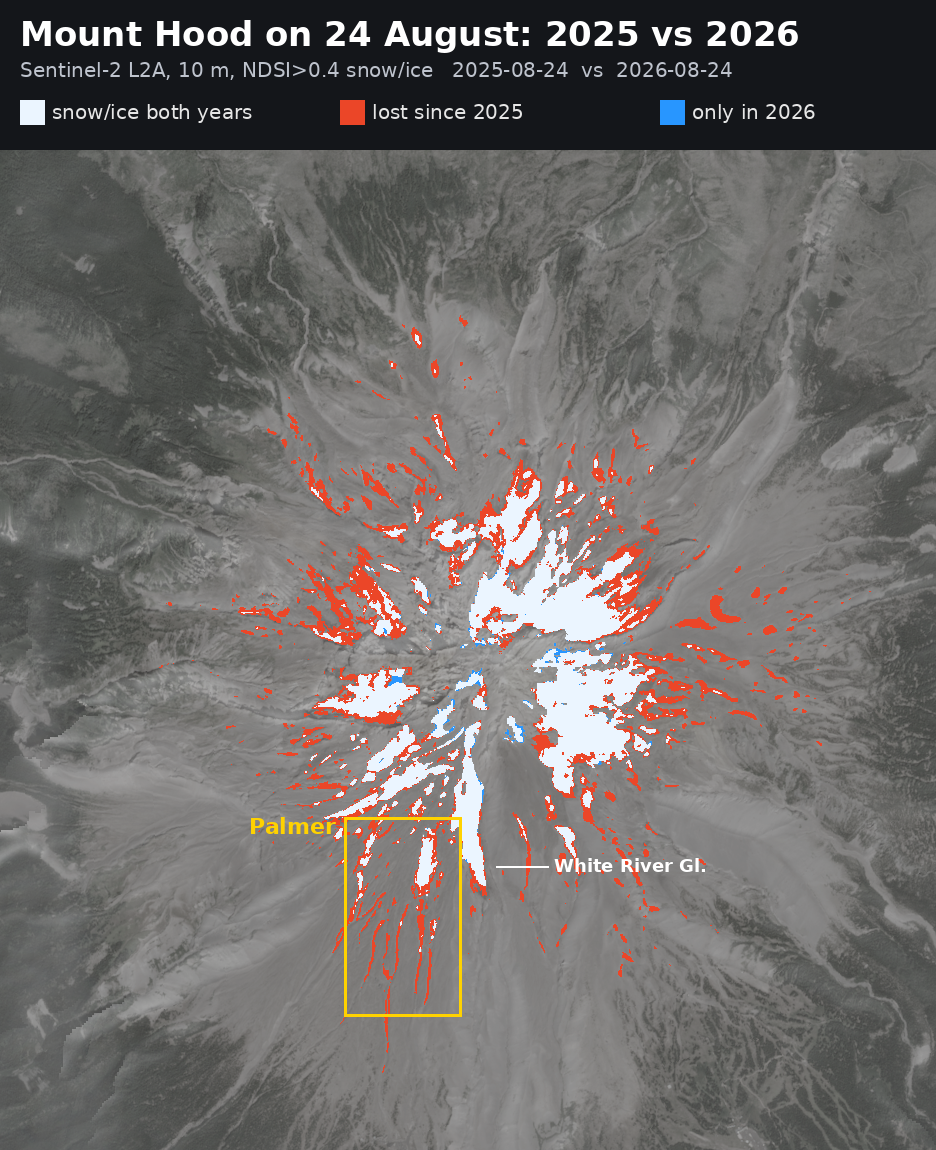
24 August 2025 against 24 August 2026. Red: snow and ice present in 2025 but gone in 2026. White: present both years. Blue: only in 2026. The yellow box is the Palmer zone; the white streak beside it is the White River Glacier.
Finding 2: the lower Palmer was bare by late August
The lower half of the Palmer was effectively gone by 24 August 2026, about five weeks earlier than in 2025.
- 24 August 2026: about 1.2 acres of snow left in the lower zone, in scattered strips.
- 24 August 2025: about 28 acres, over twenty times more.
- 2025 caught up eventually: it didn’t shrink to a comparable scrap (under an acre) until 28 September, days before the first autumn snow.
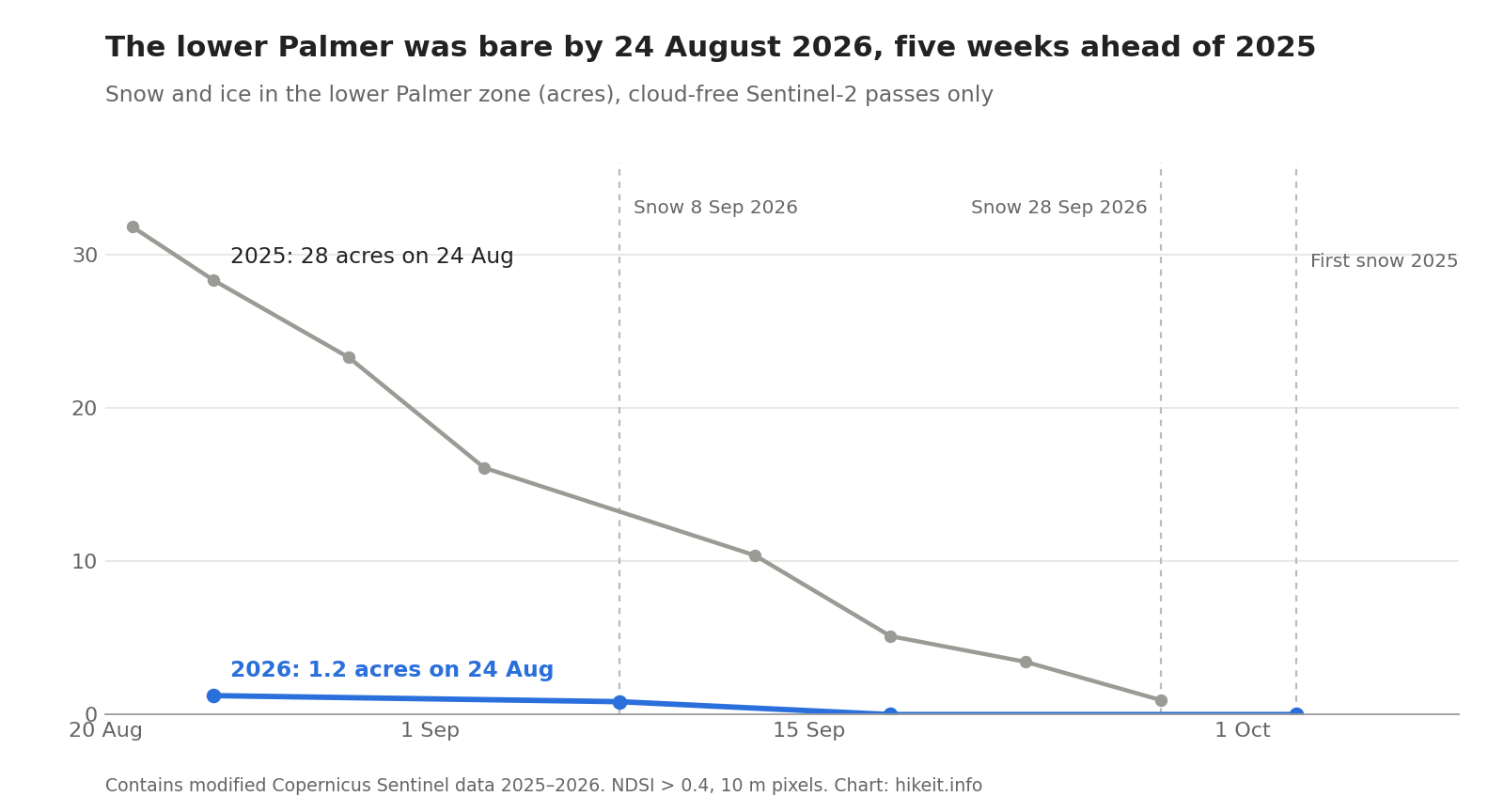
Snow and ice in the lower Palmer zone on every clear satellite pass. The 28 September 2026 pass is left out because it shows fresh snow.
After the September snowfalls melted back, the 3 October 2026 pass showed no detectable snow in the lower Palmer at all. Only about 5 acres clung on across the whole Palmer zone, near the top, and some of that may be leftovers from the 28 September snow. At the 2025 equivalent, 23 September, the Palmer zone still held 17 acres.
Across the whole mountain, the end-of-season comparison looks far less dramatic: about 830 acres in 2025 against 790 acres in 2026. That figure flatters 2026. The blue patches high on the mountain are fresh late-September snow on north-facing slopes, so the 24 August comparison is the fairer one for the mountain as a whole.
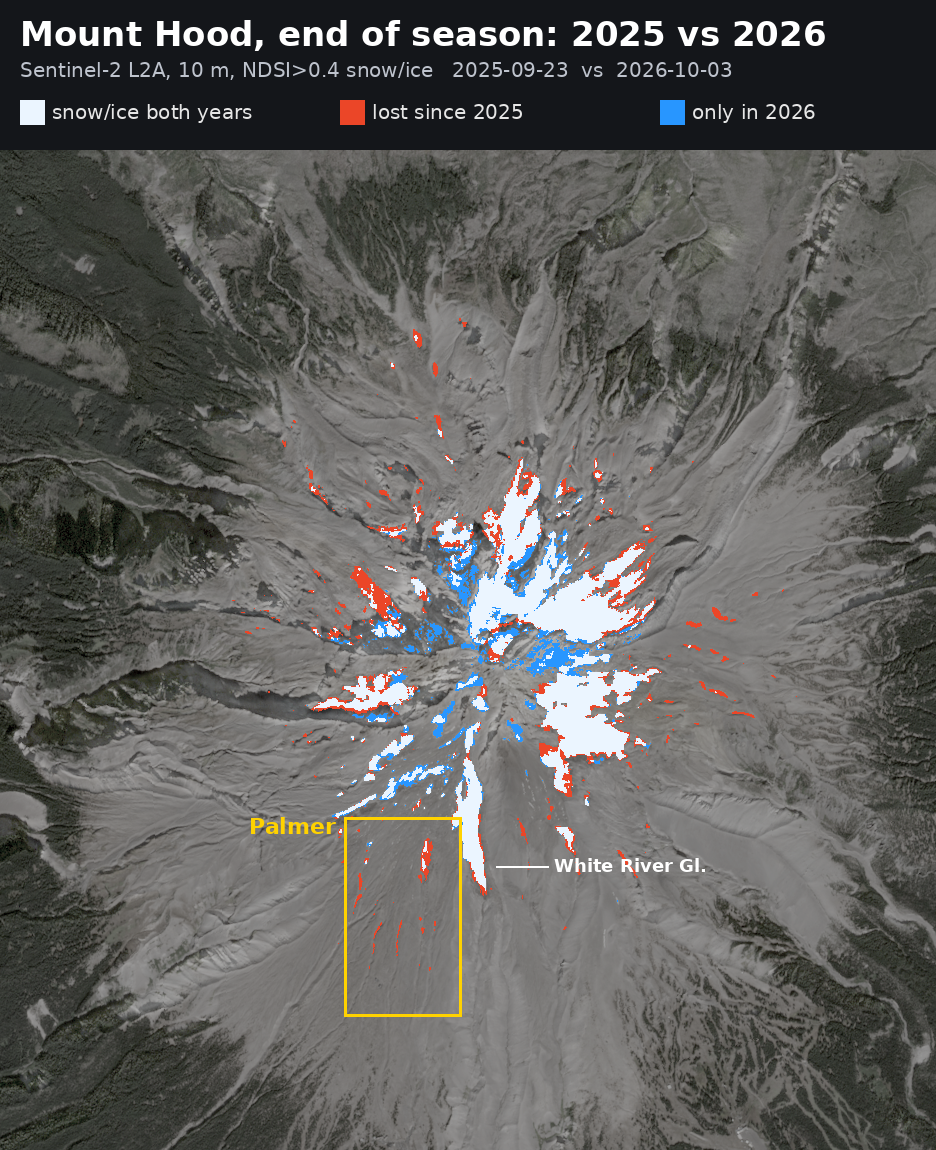
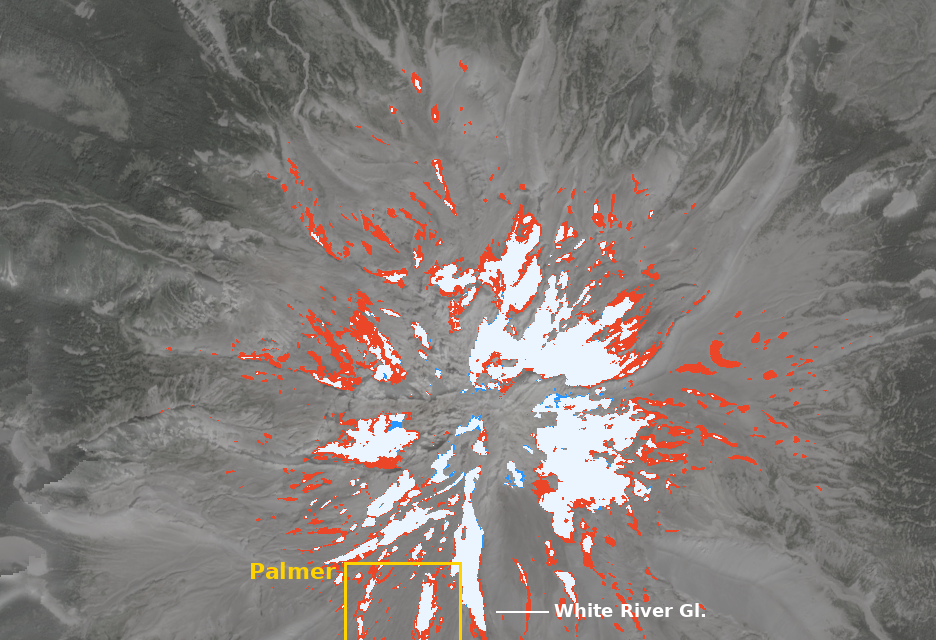
End of season: 23 September 2025 against 3 October 2026. Blue patches high on the mountain are fresh snow from late September 2026.
So, gone for the first time?
Gone earlier and more completely than last year: yes. Gone for the first time: probably not.
- 2025 wasn’t far off. The lower Palmer was down to under an acre by 28 September 2025. It ran out of summer just before it ran out of snow.
- The researchers say it’s been seasonal for a while. The Oregon Glaciers Institute found it was already melting out each late September to October by 2023 (Bakken-French et al., 2024).
The more accurate headline is a little less catchy, but no less worrying. In 2026 the Palmer wasn’t just bare for a few days before the snow came back. It was bare for weeks, and about a month earlier than the year before.
The limits of this
- Small and dirty snow gets missed. At 33-foot pixels, thin or debris-covered snow can slip under the threshold, so read these figures as “at least this much has gone”.
- Buried ice is invisible. The Palmer’s remaining dead ice sits under rock and grit, and no satellite camera can see it. This is about the surface snowfield, not the ice beneath.
- 24 August 2026 was slightly hazy. Haze can mute snow a little, but 2026 is low on every clear date, so it doesn’t change the picture.
- Snow farming. Timberline moves snow around to stretch the season, so the Palmer isn’t a purely natural record.
- Clouds chose the dates. Hood was hidden for much of September 2026, so the true low point may have fallen between usable passes.
Why it matters on the trail
The Palmer is the route most climbers take up Hood’s south side, and the reason Timberline could offer summer skiing at all. For hikers it’s also the easiest piece of Hood’s ice to see: it’s right above the lodge and the Timberline Trail.
It also fits the bigger pattern. The same 2024 study found Hood’s glaciers lost about 17% of their area between 2015/16 and 2023, at a rate about 2.6 times faster than the decades before (Bakken-French et al., 2024). A year like 2026 is what that trend looks like from the car park.
Next time you’re at Timberline Lodge in late summer, look up the slope to the Palmer lift, then across to the long white streak of the White River Glacier to its right. I’ll run this comparison again next autumn, so do send me your own photos of the Palmer from late August or September. Ground truth beats pixels.
Further Reading
- Unprecedented 21st century glacier loss on Mt. Hood, Oregon, USA (The Cryosphere, 2024) and its supplement
- Oregon Glaciers Institute: Palmer and White River Glacier
- Palmer Glacier (Wikipedia)
- Timberline Lodge ends 2026 summer ski season (Unofficial Networks)
- Watching Mount Hood’s Glaciers Disappear (my November 2025 post)
- Rod’s post on Facebook
- Copernicus Data Space Ecosystem (Sentinel-2 imagery)
Image credits: all maps and the chart are by hikeit.info and contain modified Copernicus Sentinel data (2025–2026), processed through the Copernicus Data Space Ecosystem.